Transitional justice and post-conflict in Northern Ireland: challenges of memory and reconciliation
Abstract
This article critically analyzes transitional justice in Northern Ireland after The Troubles, assessing its impact on reconciliation. Although the Good Friday Agreement (1998) was a milestone, the implementation of transitional justice measures has been fragmented and politicized. The four pillars of transitional justice —truth, justice, reparation, and guarantees of non-repetition— are examined, highlighting advances such as police reform and institutional acknowledgments of responsibility. However, significant challenges persist, including impunity, divided collective memories, and the 2023 Amnesty Law. The article concludes that, while transitional justice has contributed to institutional peace, it has not achieved deep social reconciliation. Measures to strengthen truth-seeking, collective memory, and intercommunal dialogue are proposed as essential steps toward genuine reconciliation.
Received: 15 May 2025; Accepted: 21 November 2025
Downloads
References
Aguilar, Paloma. 2013. Jueces, represión y justicia transicional en España, Chile y Argentina. Revista Internacional de Sociología, 71(2), 281-308.
Amnistía Internacional. 2023. Irlanda del Norte: la Legacy Act perpetúa la impunidad y traiciona a las víctimas. Acceso el 1 de mayo de 2025: https://www.es.amnesty.org/en-que-estamos/noticias/noticia/articulo/irlanda-del-norte-la-ley-de-legado-perpetua-la-impunidad-y-traiciona-a-las-victimas/.
Arendt, Hannah. 1958. The human condition. Chicago: University of Chicago press.
Beiner, Guy. 2018. Forgetful Remembrance: Social Forgetting and Vernacular Historiography of a Rebellion in Ulster. Oxford: Oxford University Press.
Chang, Patty, Mayesha Alam, Roslyn Warren, Rukmani Bhatia y Rebecca Turkington. 2015. Women leading peace: a close examination of women’s political participation in peace processes in Northern Ireland, Guatemala, Kenya, and the Philippines. Washington, DC: Georgetown Institute for Women, Peace and Security. https://giwps.georgetown.edu/resource/women-leading-peace/.
Davies-Janes, Rosemary. 2024. Las secuelas del conflicto norirlandés. Compassionate Inquiry. Acceso el 1 de mayo de 2025: https://compassionateinquiry.com/2024/09/las-secuelas-del-conflicto-norirlandes-con-stephen-brown/.
Dawson, Graham. 2007. Making peace with the past?: memories, trauma and the Irish troubles. Manchester: Manchester University Press.
Dawson, Graham. 2017. «The desire for justice, psychic reparation and the politics of memory in ‘post-conflict’ Northern Ireland». En Historical Justice, editado por Klaus Neumann, 265-288. Milton Park: Taylor and Francis.
De Greiff, Pablo. 2012. «Theorizing transitional justice», Transitional justice 51: 31-77.
De Greiff, Pablo. 2021. The applicability of transitional justice in pre-conflict contexts. Pathfinders. Acceso el 1 de mayo de 2025: https://cic.nyu.edu/wp-content/uploads/2023/02/The-Applicability-of-Transitional-Justice-Pablo-de-Greiff-2021.pdf.
Fearon, Kate y Mónica McWilliams. 2000. «Swimming against the mainstream: The Northern Ireland Women’s Coalition». En Camel Roulston y Celia Davies (eds.). Gender, democracy and inclusion in Northern Ireland, 117-137. Londres: Palgrave Macmillan.
Federación Internacional de Derechos Humanos. 2023. Irlanda del Norte: el Gobierno británico intenta encubrir sus crímenes. Acceso el 1 de mayo de 2025: https://www.fidh.org/es/region/europa-y-asia-central/irlanda/irlanda-del-norte-el-gobierno-britanico-intenta-encubrir-sus-crimenes.
Gamboa, Alina. 2025. «Reflections on the Belfast/Good Friday Agreement». Journal of Critical Global Issues 2(1), art. 2: https://doi.org/10.62895/2997-0083.1015.
Gilliland, Anne J. 2015. «Memory politics and reconciliation in the wake of ethnic conflict: A Northern Irish example”.
Gilliland, Anne. 2011. «Neutrality, social justice and the obligations of archival education and educators in the twenty-first century». Archival science 11: 193-209.
Hamber, Brandon y Grainne Kelly. 2005. A place for reconciliation? Conflict and locality in Northern Ireland. Belfast: Democratic Dialogue.
House of Commons Defence Committee. 2017. Investigations into fatalities in Northern Ireland involving British military personnel. House of Commons, Fourteenth Report of Session 2016–17. Acceso el 1 de mayo de 2025: https://publications.parliament.uk/pa/cm201617/cmselect/cmdfence/1064/106404.htm.
International Center for Transitional Justice (ICTJ). (2008). What is transitional justice? New York: ICTJ. Acceso el 1 de mayo de 2025: https://www.ictj.org/what-transitional-justice.
Joinet, Louis. 1997. «Informe final del Relator Especial sobre la impunidad y conjunto de principios para la protección y la promoción de los derechos humanos mediante la lucha contra la impunidad». En ONU, Comisión de Derechos Humanos. Subcomisión de Prevención de Discriminaciones y Protección de las Minorías Doc. E/CN, 4.
Kezie-Nwoha, Helen y Uchenna Emelonye. 2020. «The role of women in post-conflict reconstruction». International Journal of Gender and Women’s Studies 8(2): 131–142.
Lederach, John Paul. 1997. Sustainable reconciliation in divided societies. Washington, DC: USIP.
McWilliams, Monica y Fionnuala Ní Aoláin. 2013. «There is a war going on you know: addressing the complexity of violence against women in conflicted and post conflict societies». Transitional Justice Review 1(2): 4-44. https://doi.org/10.5206/tjr.2013.1.2.2.
Miralles, Nora. 2016. La gran mayoría de los asesinatos del conflicto del Ulster siguen impunes. Acceso el 1 de mayo de 2025: https://www.vice.com/es/article/asesinatos-conflicto-ulster-irlanda-del-norte-impunidad/.
Monks, Aoife. 2013. «‘This Painful Chapter’: performing the law in Bloody Sunday: scenes from the Saville Inquiry». Contemporary Theatre Review 23(3): 345-356.
Naciones Unidas. 1997. Principios para la protección y la promoción de los derechos humanos mediante la lucha contra la impunidad. E/CN.4/ Sub.2/1997/20/Rev.1.
Naciones Unidas. 2004. «El estado de derecho y la justicia de transición en las sociedades que sufren o han sufrido conflictos». Informe del Secretario General, Consejo de Seguridad, Documento S/2004/616.
Naciones Unidas. 2023. Expertos de la ONU instan al Reino Unido a retirar su proyecto de ley de amnistía sobre Irlanda del Norte. Acceso el 1 de mayo de 2025: https://news.un.org/es/story/2023/07/1521862.
Ní Aoláin, Fionnuala, y Catherine O’Rourke. 2010. «Gendered transitional justice and the non-state actor». En Contested transitions: Dilemmas of transitional justice in Colombia and comparative experience, editado por Amanda Lyons y Michael Reed, 115-143. Nueva York: International Center for Transitional Justice.
Orentlicher, Diane. 2005. Informe de la Experta Independiente Encargada de Actualizar el Conjunto de Principios para la Lucha contra la Impunidad. Naciones Unidas, Comisión de Derechos Humanos, 61º período de sesiones. Documento E/CN.4/2005/102.
Reino Unido. 2023. Northern Ireland Troubles (Legacy and Reconciliation) Act 2023. Londres: UK Parliament.
Ricoeur, Paul. 2004. Memory, history, forgetting. Chicago: University of Chicago Press.
Taylor, Rupert. 2006. «The Belfast Agreement and the politics of consociationalism: A critique». The Political Quarterly 77(2): 217-226.
Teitel, Ruti G. 2002. Transitional justice. Oxford: Oxford University Press.
Tobón, María Patricia, Leyner Palacios y María Ángela Salazar (dir.). 2021. Desterritorialización y despojo del pueblo negro: resistencias, memorias y justicia histórica. Bogotá: Comisión para el Esclarecimiento de la Verdad, la Convivencia y la No Repetición.
Úbeda de Torres, Amaya. 2005. «Justicia transicional y comisiones de verdad: ¿avance o retroceso en el Derecho Internacional contemporáneo?» Revista de Ciencias Jurídicas 108: 11-32.
van Zyl, Paul. 2005. «Promoting transitional justice in post-conflict societies». En Security governance in post-conflict peacebuilding, editado por Alan Bryden y Heiner Hanggi, 209-231. Münster: Lit Verlag.
WAVE Trauma Centre. 2020. Impact Report: April 2015 - March 2020. Belfast: WAVE Trauma Centre. Acceso el 1 de mayo de 2025: https://www.wavetraumacentre.org.uk/publications/impact-report-2015-2020/.
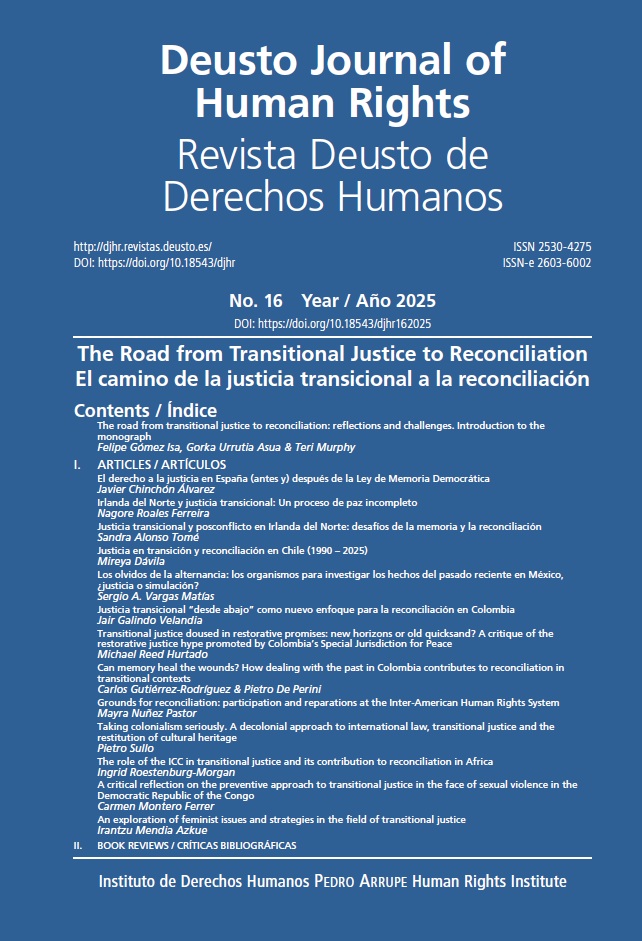
Copyright (c) 2025 University of Deusto

This work is licensed under a Creative Commons Attribution-NonCommercial 4.0 International License.
Deusto Journal of Human Rights / Revista Deusto de Derechos Humanos is an Open Access journal; which means that it is free for full and immediate access, reading, search, download, distribution, and reuse in any medium only for non-commercial purposes and in accordance with any applicable copyright legislation, without prior permission from the copyright holder (University of Deusto) or the author; provided the original work and publication source are properly cited (Issue number, year, pages and DOI if applicable) and any changes to the original are clearly indicated. Any other use of its content in any medium or format, now known or developed in the future, requires prior written permission of the copyright holder.
3.jpg)
3.jpg)
3.jpg)


.jpg)